
Water spreading right now? Do these four things first
- Close the main shutoff valve where the water line enters the house. A lever handle is closed when it sits crosswise to the pipe.
- Switch off power to wet rooms at the breaker panel, but only if you can reach it without standing in water. If the panel is wet, stay away and tell us.
- Lift rugs, move valuables and set buckets under drips. Photograph the damage and the meter before you clean, since a landlord or insurer will ask.
- Call the 24/7 line and say where you first saw water and whether it stops once the main is closed. That one fact narrows the search a great deal.
High water bill or a spinning meter? Test it yourself first
A bill that creeps up with no change in habits is the classic sign of a leak nobody can see. Allendale's own 2025 water quality report offers a simple check worth doing before you pay for a visit. Start with every faucet and appliance off, including the ice maker and any humidifier.
Then lift the meter lid and look at the meter head. On a newer all-plastic meter, a plus sign in the circle means water is moving. On an older brass meter, watch the small triangle, and if it is turning, water is flowing. Flow with everything off means the leak is somewhere past the meter.
Run the look twice, because a softener recharge can fool one glance. Then close the main valve inside the house and look again. A meter that stops means the leak is indoors. A meter that keeps moving points to the buried pipe, which becomes a water service line repair job. The same report names two usual suspects: a dripping faucet, and a toilet flapper that seals only some of the time.
What you notice, and where we look first
| What you notice | Most likely area | First check |
|---|---|---|
| Meter moves, everything off | Buried line or a hidden fixture leak | Close the house main and watch again |
| Warm patch on the floor | Hot water line under a slab | Feel the floor, listen at night |
| Stain grows only when a shower runs | Drain, shower pan or tub trap | Run one fixture at a time |
| Stain grows with nothing running | Pressurized supply line in a wall or ceiling | Moisture reading around the stain |
Slab leak signs: warm spots, a running meter and a hissing floor
A slab leak is a pressurized line leaking beneath a concrete floor. It rarely makes a puddle at first, so the clues are quiet.
Warm or hot spots
A patch of floor that feels warm underfoot, or hot water that takes longer to arrive, can mean a leaking hot line below.
A meter that will not rest
With every fixture off, a meter that keeps showing flow and a bill that has climbed are the most reliable signs.
Sound
In a quiet house at night, a faint hiss or running water from the floor deserves a listening visit.
Slab leaks: what happens once it is found
We locate the leak first, then explain the choices. Sometimes the line can be rerouted through the walls or attic and the concrete left alone. Sometimes the slab is opened over the exact spot. If the whole line is tired, our repiping page explains when replacing it beats chasing one spot at a time.
Ceiling and wall leaks: why the stain is rarely under the pipe
Water travels along joists, studs and pipes before it shows, so a brown ring on the dining room ceiling can sit several feet from the source. Cutting a hole where the stain is often finds nothing.
A stain that grows only while someone showers points to a drain or shower pan. One that grows with nothing running points to a supply line. One that appears only after rain may be a roof problem, which is outside what we do, and we will say so rather than open your ceiling. A moisture meter and a thermal camera let the opening be the size of a hand.
Leaks under the house: crawlspace and basement ceiling lines
Where supply pipes run in the open, look for a sagging wet strip of insulation, rust streaks on pipe hangers, a musty smell, or drips you can hear from the floor above. Winter raises the stakes, because a small weep can become a split pipe after a hard freeze.
Do not crawl into a space with standing water near wiring. Tell us what you can see from the access hatch and we will plan the safest way in. A split line moves the job to burst pipe repair.
How we find a leak without tearing things open
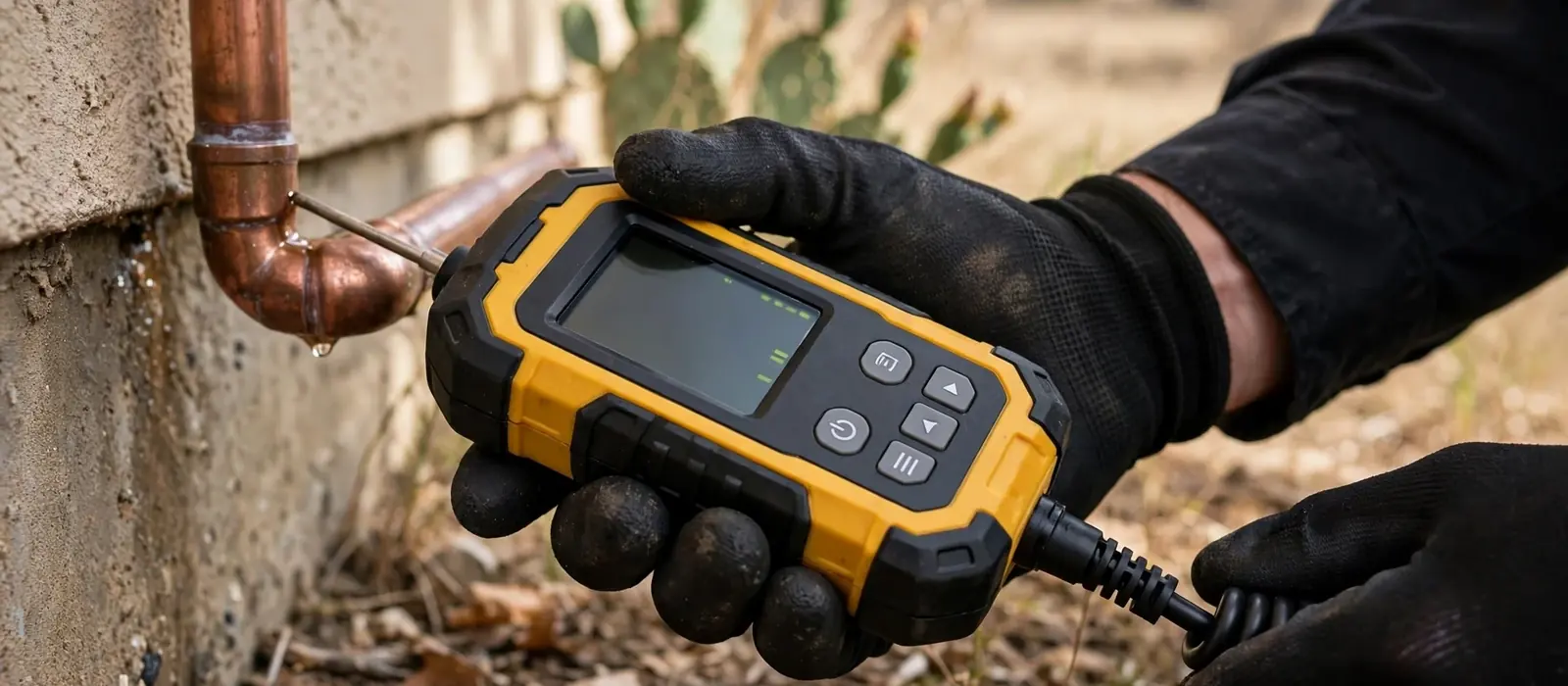
Listening equipment picks up the sound water makes escaping a pressurized pipe, through a floor, wall or the ground. Moisture meters and thermal cameras read dampness and temperature differences. Pressure tests close off a section of pipe and watch a gauge to see if it holds.
None of these finds every leak. A very slow weep behind tile or a line under thick concrete can narrow to an area, not a point. We say so plainly, and talk through whether to keep searching or reroute the line.
Sprinkler and irrigation leaks
A zone that stays soggy, weak spray at the heads and a summer bill that jumps are the signs. Shut the irrigation supply off at its own valve and repeat the meter test. If the meter stops, the leak is on the sprinkler side. After a hard winter, cracked fittings often show only when the system is turned on in spring.
Pool and spa lines, and leaks in drain pipes
For a pool or spa we look at the plumbing side only: fill lines, equipment pad piping and valves. A bucket on a step, compared with the pool level over a day, separates evaporation from real loss. Liner and shell leaks belong to a pool company.
A drain pipe leak is quieter. Think slow drains, a sewer smell, a damp spot under a tub or gnats at a floor drain. A camera run, as on our sewer line inspection page, shows cracks and offset joints.
Allendale, MI: young homes, renter turnover and small failures
Census estimates put the median Allendale home at a build year of 2003, with only about 16 percent of units built before 1980. Most leaks here are not worn-out pipe. They are fixture and connection failures: supply stops, braided hoses, toilet fill valves, water heater connections and ice maker lines.
About 47 percent of households in the Allendale CDP rent. A leak often surfaces at turnover, when a unit sits empty or a new tenant opens a cabinet. Landlords can save a lot of damage by reading the meter on vacant units and checking under every sink at each move-out. The same leak checks apply for owners in Jenison, just a few miles east.
Source: Census Bureau ACS 2020 to 2024 estimates via Census Reporter.
What happens when you call
Three questions
Where the water showed up, whether the meter moves with everything off, and whether the main valve helps.
A first step
We tell you what to shut off or leave alone while a technician is on the way.
Locate the leak
Listening, moisture and thermal checks, and pressure tests as needed.
The price
The clear price for any repair comes before work starts.
What affects the price of leak detection
A leak behind one bathroom wall and a leak somewhere under 40 feet of yard are not the same job. Here is what moves the number.
One room with a clear stain is quicker than a whole house and a meter that moves.
Open crawlspace pipes are easy. Lines in finished walls, under tile or beneath a slab take more care.
Listening may be enough. Some jobs also need pressure testing or a camera.
Some owners want a location for their own contractor. Others want the repair done.
Fixing the first leak and finding a second is common, and it changes the plan.
Not sure it is a leak, or whether it can wait for morning?
Describe the meter, the stain or the sound. We will tell you whether it needs a same-day visit or can safely wait.
Call (855) 575-2890