
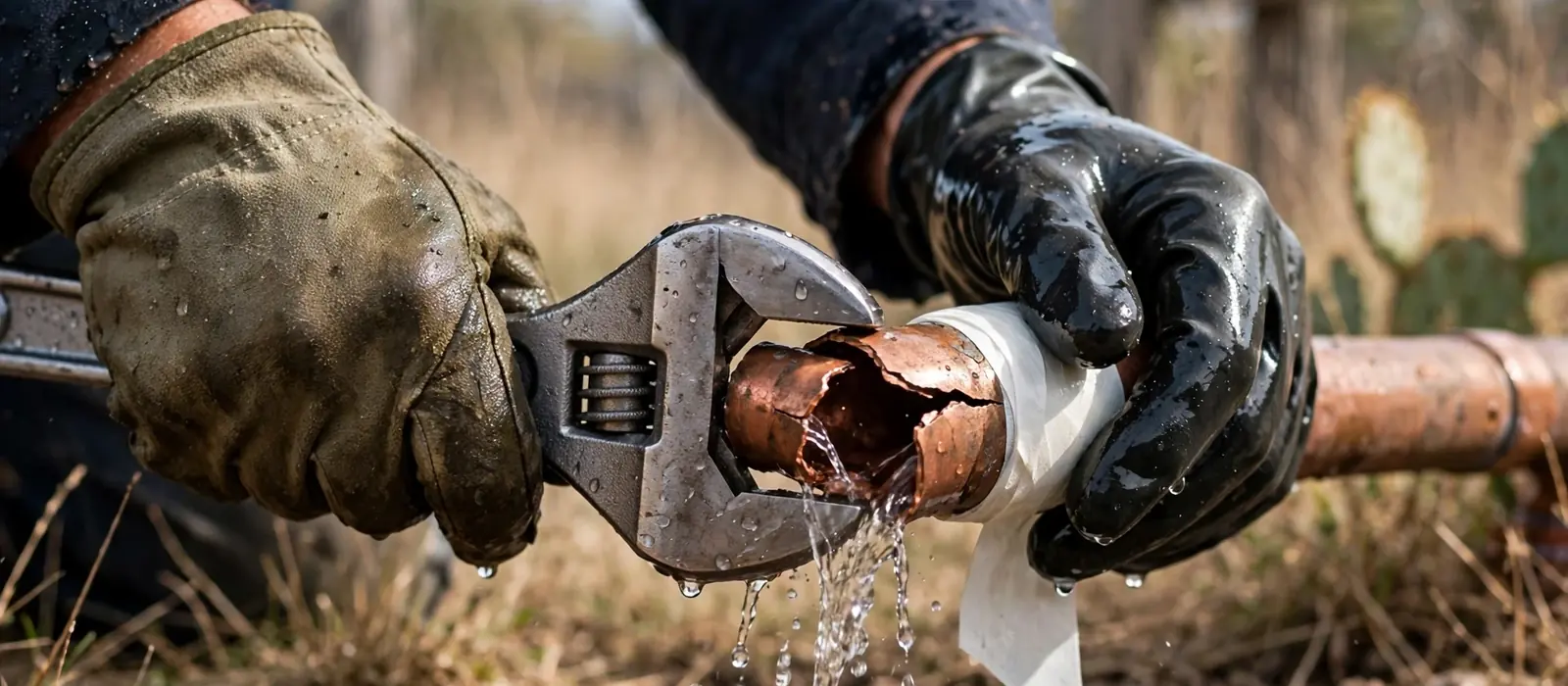
Signs a pipe has burst, not just dripped
A sudden loss of pressure
Every tap runs weak at once, or a tap sputters, and nobody used a lot of water.
A hiss or rush behind a wall
Water escaping under pressure makes a steady sound that does not stop when fixtures are off.
A fast-growing stain
A wet ceiling or bulging drywall that changes in minutes, not days, is a pressurized line.
A meter that races
With fixtures off, a meter dial moving quickly means a large opening somewhere past it.
Burst pipe right now: what to shut off first and in what order
Do these in order. Each takes under a minute and stops the damage from growing while the plumber travels.
- Water first. Close the main shutoff valve. If you cannot find it or it will not turn, tell us when you call.
- Water heater second. Switch off the power or turn the gas control to its lowest setting, so the tank does not heat while the lines are drained.
- Electricity third. Turn off breakers for any room where water is falling or pooling, and do not touch outlets or cords near water.
- Drain the lines. Open the lowest cold tap and the highest cold tap to relieve pressure, and keep buckets under the ceiling.
Frozen pipe: why it can be cracked but not leaking until it thaws
When water freezes inside a pipe, the ice expands and can split the pipe wall. The ice itself plugs the opening, so nothing leaks while it stays frozen. The trouble starts when it warms up, the plug melts and the line is under pressure again.
That is why a frozen pipe is worth treating as a possible burst before the thaw. If you find a tap that gives only a trickle on a very cold morning, close the main valve before you start warming anything, then thaw with the main closed and a nearby faucet open so you can see when water returns.
Thawing a frozen pipe: safe and unsafe
What not to do
- Never use a torch, a propane heater or any open flame on a pipe, since the wall behind it can ignite.
- Do not pour boiling water over a pipe or run an electric heater near standing water.
- Do not leave the main open and walk away while a section thaws.
- Do not keep heating a pipe that has stopped giving you results. Stop and call.
What works
- Open the nearest tap so thawing water has somewhere to go.
- Warm the pipe slowly with a hair dryer or heating pad, working from the faucet end back toward the frozen spot.
- Open cabinet doors under sinks on exterior walls to let room air reach the pipes.
- If a joint or section shows a crack, close the main and call the 24/7 line.
Cold, in plain numbers
These are temperature readings and long-run averages, not reports of damaged pipes. They explain why a freeze plan matters in this part of Ottawa County.
Frost depth, and what 42 inches does and does not tell you
Michigan's residential code lists a frost line of 42 inches. That figure is for footings and foundations. It is not a rule for how deep a water line is buried, so do not assume your service pipe sits below it.
The practical step is simple. Know where your main shutoff is before a cold night, keep a cabinet door open on exterior-wall sinks, and let a tap drip on the coldest nights. If a pipe in an unheated garage or crawlspace has frozen before, tell us when you call and we will look at insulating or rerouting it. We work the same way for Coopersville callers to the north.
Pipe leak repair: pinholes, joints and split sections
Not every burst is a catastrophe. A pinhole, a failed compression fitting or a cracked elbow can be cut out and replaced with new pipe and fittings in a short visit. We replace the damaged section and tell you honestly if the rest of that run looks tired.
If the pipe near the break is soft, flaking or full of earlier patches, one repair is not likely to be the last. In that case we explain the cost of a larger section against the cost of coming back, and you choose.
Copper pipe issues we see after a break
Copper holds up well, but it has its own failure modes. Freezing splits it along the seam. Pinholes appear on the inside surface of an aggressive water line and can show up in several places along a run. A soldered joint that was never fully sealed can weep for years before it lets go.
A single repair on copper is straightforward. Repeated pinholes in different spots are the signal that the line is wearing from inside, and that is the point where repiping deserves a quote. A split on the supply to a tank belongs with water heater repair.
What happens when you call the line
Shutoff first
We walk you through the main valve and the water heater by phone, even before we have the address.
Same-day dispatch
A technician is sent as soon as one is available, day, night, weekend or holiday.
Find and fix
We trace the break, and if the source is hidden we may use the methods on our leak detection page.
Clear price
You hear the price before we cut a pipe or begin repairs.
What affects the cost of burst pipe repair
A pipe repair can be quick or a multi-day project depending on what broke and where. These are the biggest factors.
An exposed pipe in a basement is faster than one inside a finished ceiling or a wall.
Copper, PEX, CPVC and older steel each need different fittings and techniques.
Opening a wall costs time. Patching drywall afterward may be a separate trade.
One clean break is a short job. A weak run with several failures changes the plan.
A night, holiday or storm call means the tech comes out of normal hours. You hear the price first.