
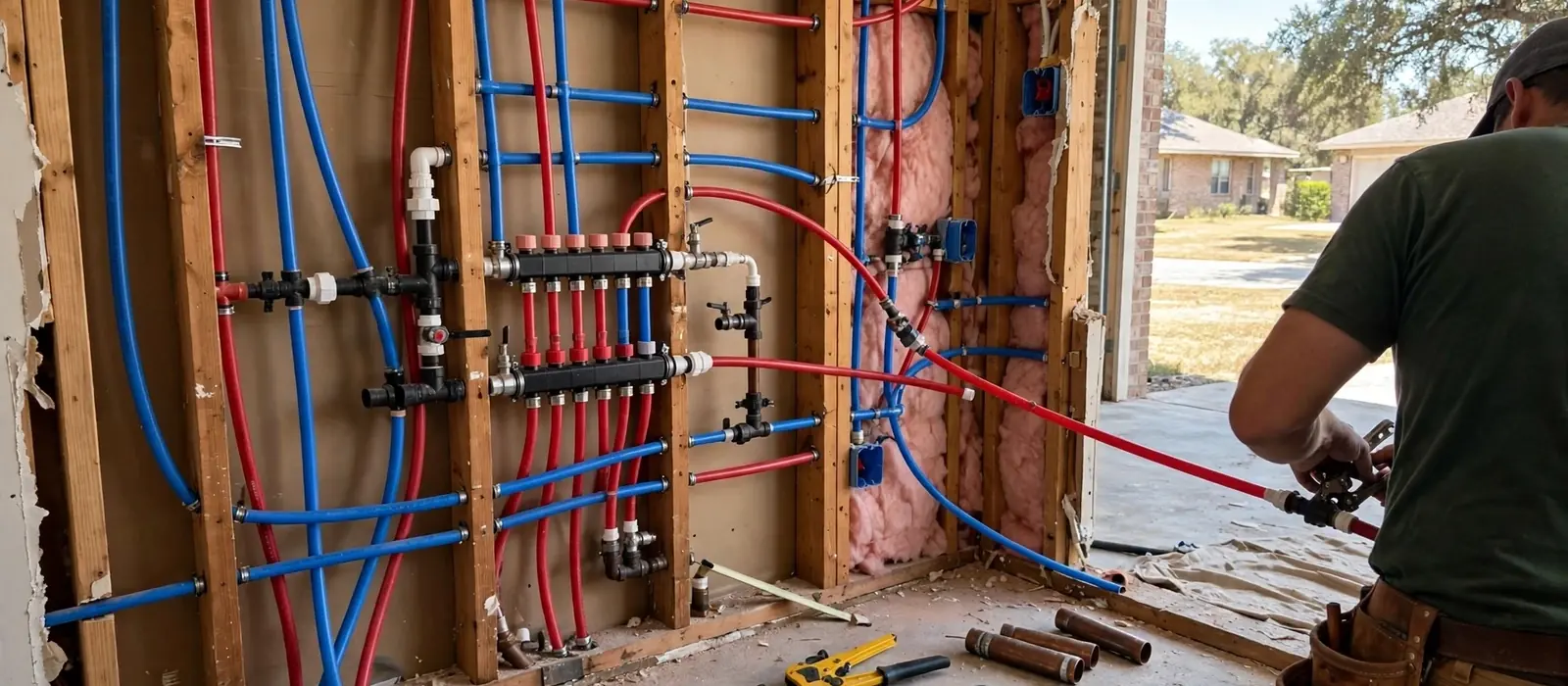
Does a young town like Allendale need repiping?
Usually not, and we would rather say so. Allendale's housing is young. The median home was built in 2003, about 16 percent of units predate 1980 and only about 3.5 percent predate 1940. Most plumbing problems here are fixture and connection failures, not worn-out piping.
Repiping is mainly a question for older homes, rural farmhouses and the nearby towns with older stock. If you own a house built long before 2003, or one in Walker, Jenison or Marne, the age of the pipe is worth a conversation. Our Walker plumber page covers the east side of the river.
Median year built, side by side
These are Census estimates. They show where repiping questions are more common, and they say nothing about what is inside your walls.
Is galvanized pipe failing? How to tell
Galvanized steel pipe has a zinc coating. Over decades the zinc wears away and the steel rusts, mostly on the inside, where nobody can see it. Rust and mineral buildup narrow the pipe, so flow drops long before anything leaks.
Weak flow at several taps
Pressure is fine at the meter but poor in the house, especially at the farthest fixtures.
Brown or rust-colored water
Especially on the first draw after the water sat overnight.
A magnet sticks
Steel pipe attracts a magnet. Copper and plastic do not. It is a simple way to know what you have.
Flaking at joints
Rust bloom around threaded fittings, or leaks that return after a repair, are late signs.
PEX versus copper: how the two compare for a repipe
Both are good replacement materials. The right one depends on the house and on your priorities.
| Point | PEX | Copper |
|---|---|---|
| Installing | Flexible tubing that bends around corners, often fewer joints and fewer wall openings | Rigid pipe soldered at each joint, more cutting and more fittings |
| Material cost | Generally lower | Generally higher |
| Freezing | Tolerates some freezing better than rigid pipe but can still split | Can split along the seam when frozen |
| Sunlight | Must stay out of sunlight | No issue |
| Water chemistry | Not affected by corrosion | Can develop pinholes in aggressive water |
| Repairs | Special fittings and tools | Solder, often a plain fix for any plumber |
Copper pipe questions
Copper is a proven material, and if a house already has it, replacement is not automatic. Many copper systems run for decades. What changes the answer is a pattern: pinholes at several spots along a run, green staining at joints, or repeated leak repairs. One pinhole is a repair. Three in a year is a pipe wearing out.
Cast iron drain lines
Water supply is only half the picture. In older houses, the drains can be cast iron, which rusts from the inside out, develops rough scale that catches paper and grease, and can crack at the hubs or sag where a support has shifted. Slow drains in several fixtures and repeated clogs in the main are the usual clues.
Before anyone proposes pulling out a drain stack, a camera inspection shows the actual condition. Our sewer line inspection page explains what the camera sees and what it cannot. A split supply pipe on any material is a job for burst pipe repair, and a failing buried line is covered under water service line repair.
Phased repiping or the whole house at once
Phased repipe
- Spreads cost and disruption across several visits.
- Starts with the worst run, such as a bathroom group or the kitchen.
- Leaves old and new pipe in one house, with fittings where the two meet.
- Works well for rentals, where units turn over at different times.
Whole house at once
- One disruption, one set of wall openings, one patching job.
- Water is off for the work period, and we tell you how long before we start.
- New piping throughout and one clean set of connections.
- Usually the better value when most of the original piping is in poor shape.
Access and drywall: the honest version
Repiping a finished house means opening walls and ceilings in some places. How much depends on where the pipes run, how the house was framed and whether there is a basement, crawlspace or attic with open access. Flexible tubing needs fewer openings than rigid pipe, but it is never zero.
We tell you where the openings will be before work begins. Drywall patching and painting are often a separate trade, and we say so up front. For permits and inspections, the township uses Professional Code Inspections, so ask them, and us, what applies to your job.
How a repipe gets planned
You call and describe
Age of the house, what you see in the water, and what you have already repaired.
We look at the pipe
We identify the material, check pressure and look for access points.
You hear the options
Phased or whole house, PEX or copper, repair or replace, with a clear price for each.
Work is scheduled
We set dates, explain how long water will be off, and describe the wall openings.
What decides the price of a repipe
Repiping is priced by the house, not by a catalog. These are the big levers.
More bathrooms, more fixtures and more feet of pipe.
PEX and copper differ in material and labor.
Open basement or attic runs cost less than lines inside finished walls.
Replacing a cast iron stack or tying in new drains adds to the job.
Several smaller visits add trips but spread the cost.