
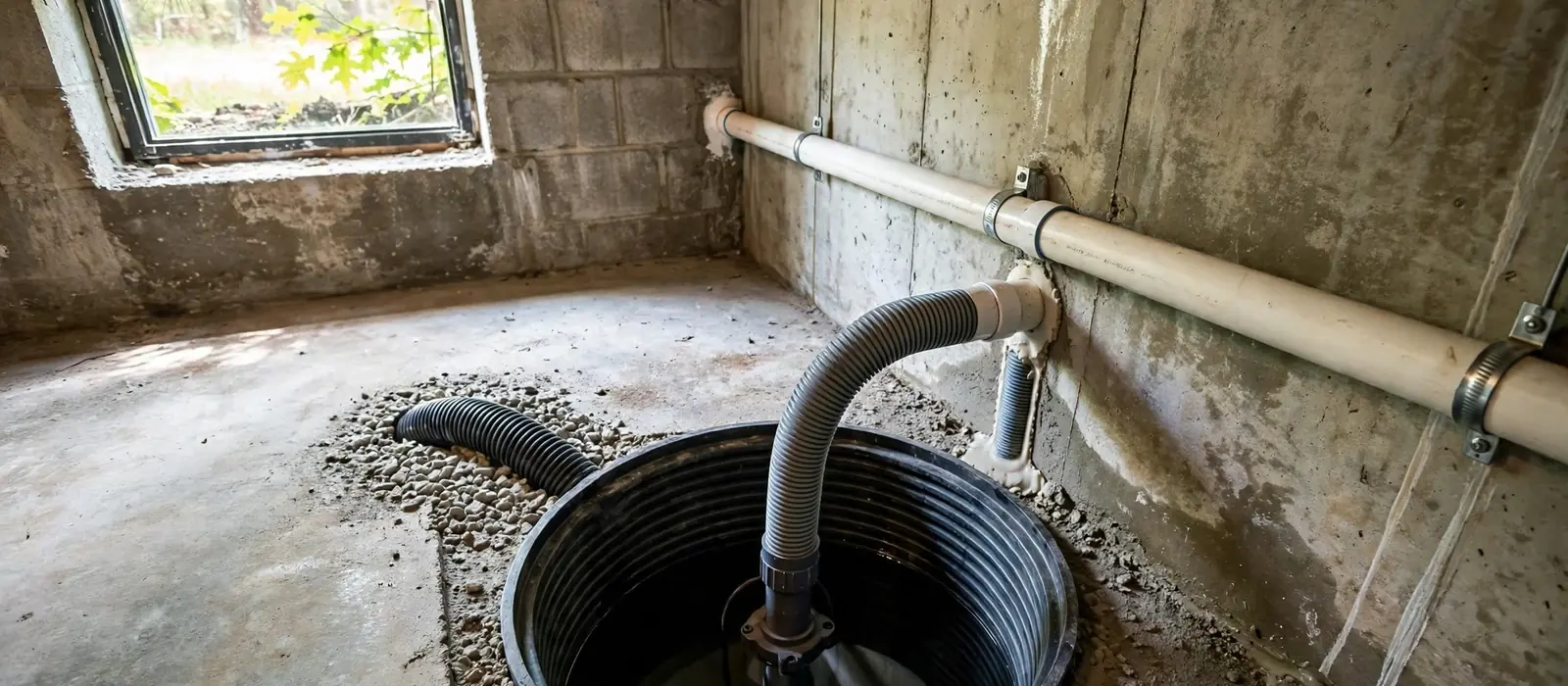
Signs a crawl space may need a pump
Not every damp crawl space needs one. Gutters and grading come first, and we cover that below.
Water after thaw or hard rain
Standing water or a wet ground cover in a low spot after the spring thaw or a long rain is the usual reason for a pit.
Musty smell and wet insulation
A damp smell in the house, or floor insulation that is wet or sagging, can point to moisture underneath.
Moisture after the gutters are fixed
If the roof water is handled and the crawl space still floods, a pit gives the water somewhere to go.
Fix the cheap sources of water before you cut a pit
Roof water is a common culprit. Make sure gutters are clear, downspouts end several feet from the foundation, and the soil slopes away from the house.
If the crawl space is still wet, a leaking supply or drain pipe is worth ruling out. A pump will keep removing water that a broken pipe keeps adding. Our sump pump work begins with that question, and if water seeps through walls or floor, basement waterproofing is the next conversation.
How the pit and pump go in
Pick the low spot and cut the pit
Choose the lowest part of the crawl space, ideally close to where the discharge will leave the house. Dig deep enough that the liner rim sits at the ground surface, and lay a few inches of gravel in the bottom.
Set the liner
Place the perforated liner, backfill around it with gravel, and make sure it is level. A lid keeps debris out and crawl space air from drifting up through the pit.
Install pump, pipe and check valve
Stand the pump on a flat base so it does not pull in silt. Add the check valve a short way above the pump, so water in the pipe does not run back into the pit. Make sure the float swings freely and does not touch the wall.
Run the discharge and test
Take the line out through the rim joist or foundation wall with a sealed opening. Pour in a bucket of water, watch the float rise and the pump start, and confirm water leaves the outlet.
Where the discharge goes, and where it must not
Send the water outside, well away from the foundation, onto ground that slopes away from your house and your neighbor's. Avoid pointing it at a driveway where it will ice over, and keep it off a neighbor's lot. Slope any outdoor run downhill so it drains, because a full pipe can freeze in winter.
The sanitary sewer is not where a sump pump belongs, and clean groundwater does not belong in that system. Whether any other tie-in is allowed depends on where you live, so ask your township or inspector what is allowed before you plan the route. We are not going to quote a rule here, because the answer is theirs to give.
Discharge options at a glance
| Option | Works well when | Watch for |
|---|---|---|
| Pipe end on the lawn, away from the house | The yard slopes away and the outlet is a good distance from the foundation | Water running back toward the house, ice in winter, runoff onto a neighbor's lot |
| Buried line to a lower part of the yard | There is no gentle slope, or you want the outlet far from the house | Trenching needs a MISS DIG 811 call first, and the pipe must drain fully so it does not freeze |
| Sanitary sewer | Not a sump pump destination | Do not do this, and ask your township if you are unsure what is allowed |
Call MISS DIG 811 before the discharge trench
Call 811 or go to missdig811.org at least 3 business days before any digging, for a project of any size. It costs nothing and the line is open around the clock. Public utilities get marked, but private lines such as a yard light feed or a lawn irrigation line are not, so look for those yourself before the shovel goes in.
Power: GFCI, a dedicated outlet and a backup
Plug the pump into a GFCI-protected outlet, ideally one that serves only the pump. Do not run an extension cord as a permanent fix. If there is no outlet near the pit, adding one is a job for a licensed electrician, and we will tell you plainly when a job needs one.
A battery backup or a second pump helps when a storm knocks out power. Test the float and pump with a bucket of water in spring and again before winter.
Allendale, MI: river land and the flood map
The Grand River forms the northern and eastern boundaries of Allendale Township, and the township's Master Plan notes that much of the land next to it is in the FEMA 100-year floodplain. Bass River State Recreation Area (1,665 acres) and the Bass River basin wetlands sit in the northwest. If your home is near either, look up your parcel on the FEMA flood map and ask the county or township what that means before you cut a pit.
A flood map is a planning tool, not a report on your crawl space. A parcel outside the mapped floodplain can still have a wet crawl space, and one inside it can stay dry. Watch your own crawl space after the next hard rain or thaw, and write down what you see.
Source: the township's Master Plan, and the FEMA flood map it refers to.
Do it yourself, or bring in help?
The same split applies in Allendale, Coopersville and Marne, where we also install sump pumps.
Reasonable for a careful DIYer
- Cutting the pit and setting the liner in clean soil
- Setting the pump, check valve and discharge pipe
Call us, or an electrician
- A new circuit or outlet, which belongs with a licensed electrician
- Water arriving faster than one pit can handle
- A discharge route that crosses a property line or needs a trench
- Standing water you cannot explain, where a leaking pipe may be the source
Wet crawl space and not sure why?
Call us any hour. We will help sort out whether it sounds like groundwater, a leaking pipe or a failed pump, and give you the clear price before work starts.
Call (855) 575-2890