
Sump pump failed and water rising? Right now, do this
- Look at the pit. If water is near the top and the pump is silent, check that it is plugged in and the GFCI outlet has not tripped. Do this only if the outlet is dry.
- Look at the float without reaching into the pit. If it is jammed against the wall or a pipe, say so on the call, since a stuck float is a fix we can make for good.
- Move stored items, electronics and anything cardboard off the floor, and stay away from standing water that touches outlets, extension cords or the panel.
- Call the 24/7 line and tell us whether water is in the pit, on the floor, or coming up from a floor drain.
What the pump is doing, and what it usually means
| Symptom | Likely cause | What we check |
|---|---|---|
| Does not start, pit is full | Dead motor, tripped power, stuck float, failed switch | Power, float travel, switch, impeller |
| Runs constantly | Stuck float, failed check valve, undersized pump, high groundwater | Float position, check valve, discharge flow |
| Runs but water barely leaves | Clogged impeller or discharge, frozen or kinked line | Intake screen, discharge outlet, line slope |
| Short cycling on and off | Check valve leaking back into the pit, float set too low | Check valve and float height |
| Loud grinding or rattling | Worn bearings or debris in the impeller | Intake, impeller, motor sound |
Allendale, MI: the Grand River, wetlands and your parcel
The Grand River forms the township's northern and eastern boundaries, and the township Master Plan notes that much adjacent land lies in the FEMA 100-year floodplain. The Bass River basin and its wetlands sit in the northwest. We are not saying homes here flood. We are saying that the water table near the river is a real factor for a basement.
So check your own parcel on the FEMA flood map, and ask the county or the township what it shows for your address. If your lot is near the river or the wetlands, a battery backup and a high-water alarm earn their cost much faster than they do on high ground.
Source: the Allendale Charter Township Master Plan.
Battery backup, check valve and where the water goes
A backup system is a second pump on its own battery, so a power cut during a storm does not stop the pit from emptying. A high-water alarm is the cheapest add-on, because it tells you before the water reaches the floor.
The check valve sits on the discharge pipe just above the pump. It keeps the water that has been pumped out from running back into the pit. When it fails, the pump short cycles and wears out early. A valve that clunks loudly on each cycle usually needs replacing.
Where the discharge ends matters. It should carry water well away from the foundation, so it does not circle back into the pit. A buried discharge line means digging, so call MISS DIG 811 at least 3 business days ahead. Whether sump water may go to the street or storm drain is a local rule, so ask the township.
Installing a sump pump: the basics
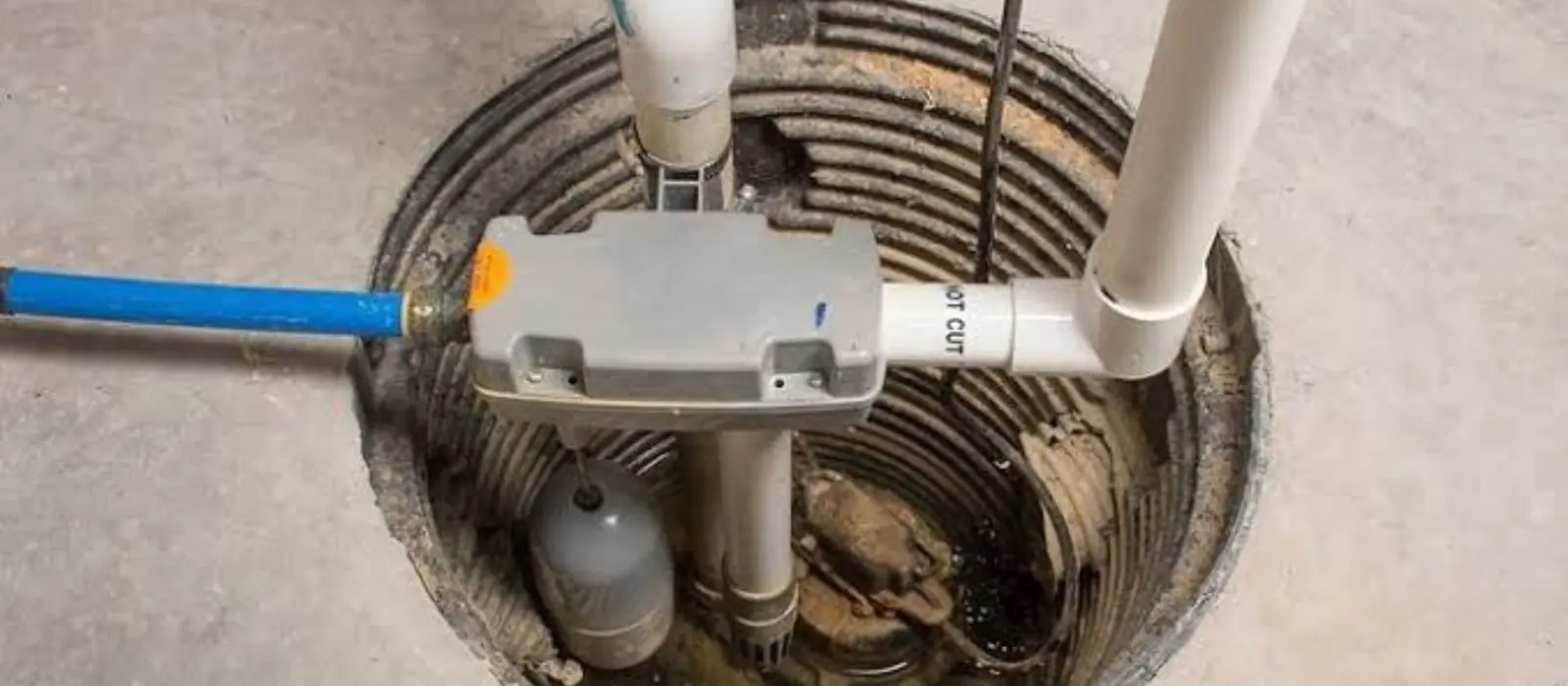
A sump basin is a lined pit in the lowest part of the floor, with a pump seated on a firm base. The pump needs its own grounded outlet, a float that can swing without touching the pit wall, a check valve and a discharge pipe that exits the house with a downward slope.
Size matters. A pump that is too small runs nonstop in a heavy week, and one that is too large short cycles and burns out sooner. We look at how much water the pit actually receives before recommending a model. If the existing pit is cracked or silted, replacing the pump alone is not enough.
Sump pumps versus ejector pumps
A sump pump moves groundwater and storm water. An ejector pump moves wastewater from a basement bathroom, laundry or utility sink up to the sewer line. The two look similar but are not interchangeable. An ejector sits in a sealed, vented basin and handles solids.
Both fail the same way: a float that sticks, a switch that wears, a motor that burns out. Both also fail at bad moments. If a sewage smell comes with a pump alarm, call right away and keep the basement closed off. Sewer-side clogs that back up into a basement are handled by sewer line cleaning.
If the pit is cracked or the floor keeps seeping, see basement waterproofing, and a new pit and outlet fall under plumbing installation. We serve Marne callers too.
What happens when you call about a pump
Quick phone triage
We ask whether the pit is full, whether there is power and what the float is doing.
Same-day visit
When a technician is available the visit happens the same day, including nights and weekends.
Diagnose
We test the pump, float, check valve and discharge, not just the motor.
Choose and price
Repair, replace or add backup. You hear the price before work begins.
What affects the cost of sump pump service
A float adjustment costs far less than a new pit and backup. These factors set the number.
A new switch or check valve is a small job. A full pump swap is larger.
Horsepower and flow rating are matched to the pit and to how much water arrives.
A second pump, battery and alarm add equipment and labor.
A cracked basin or a frozen line needs more work than a pump swap.
A call in the middle of a storm is handled outside normal hours. You hear the price first.
Pump silent in a storm?
Call now. We pick up 24/7 and will book a same-day visit when a technician is available.
Call (855) 575-2890