
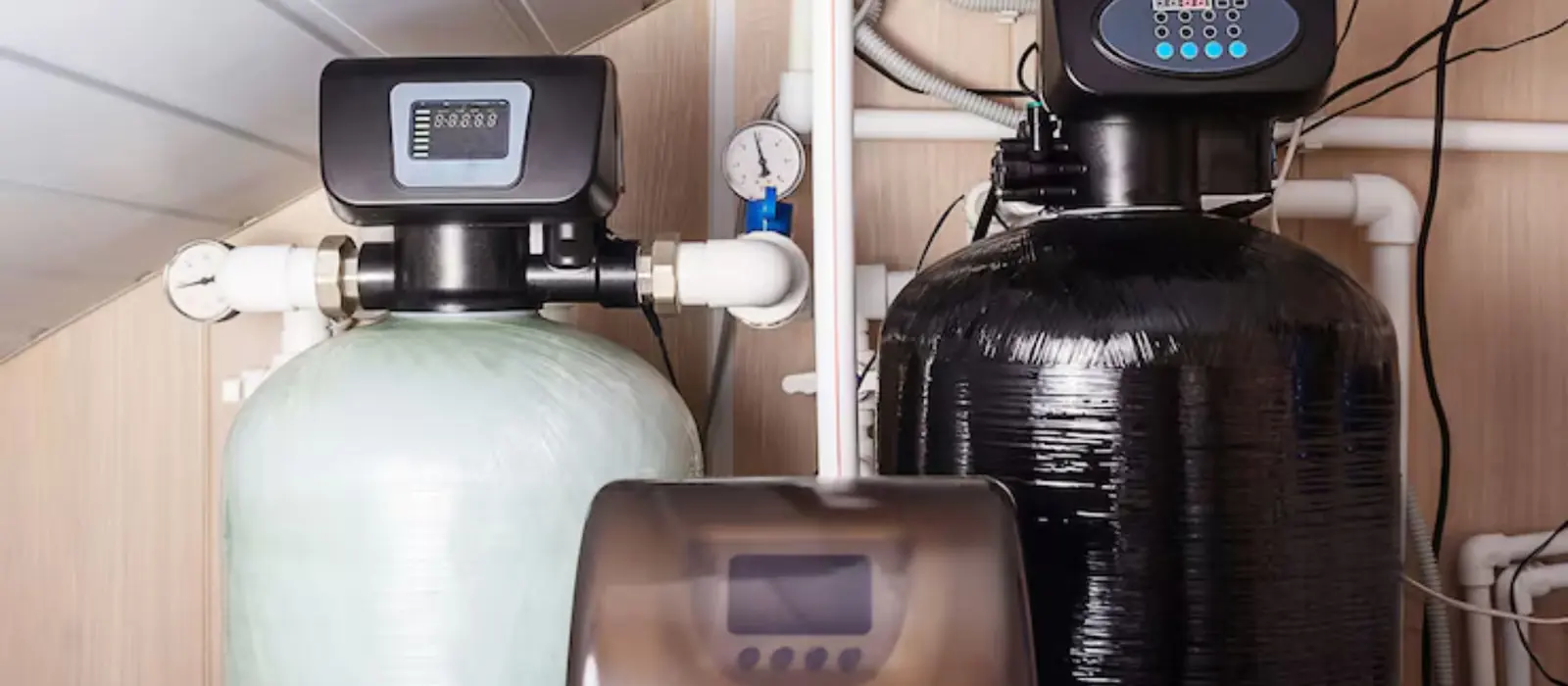
Test the tap before you buy equipment
The Grand Rapids Water System, which supplies Allendale Township, reported a 2025 average plant-tap hardness of 142 mg/L, or 8.3 grains per gallon. Divide milligrams per liter by about 17.1 and you get grains per gallon. That number is a plant average from Grand Rapids, not a reading at your faucet.
Allendale's own 2025 water quality report prints no hardness figure. So test your tap with a home test kit for a rough number, or send a sample to a lab for an exact one. We size equipment from that test, not from a guess.
Softener, filter or reverse osmosis: what each one does
| Equipment | What it does | What it does not do |
|---|---|---|
| Water softener | Swaps calcium and magnesium for sodium or potassium, cutting scale in pipes and heaters | Does not filter chlorine taste, bacteria or most contaminants |
| Carbon filter | Reduces chlorine taste, odor and the items its certification lists | Does not remove hardness |
| Reverse osmosis | Reduces many dissolved minerals and contaminants at one tap, usually under the kitchen sink | Does not soften the whole house, and it is slow |
A filter's label tells you what it was tested to reduce. If a claim does not name the thing you worry about, it does not cover it.
Salt softener versus salt-free: the honest comparison
| Question | Salt-based softener | Salt-free conditioner |
|---|---|---|
| Removes hardness minerals? | Yes, by ion exchange | No, it changes how scale forms |
| Upkeep | Add salt, occasional cleaning | Little upkeep, cartridge or media replacement |
| Drain water | Regeneration sends brine to a drain | No brine discharge |
| Soap and skin feel | Slick, soft feel | Water still feels hard |
| Best fit | Heavy scale, appliances and fixtures | Light scale where you want less maintenance |
Sizing a softener in grains
Softeners are rated in grains, such as 24,000, 32,000 or 48,000. Multiply the household's daily water use by the hardness in grains per gallon. As an illustration only, a family of four using about 300 gallons a day on the Grand Rapids average of 8.3 would need to remove about 2,490 grains a day, or about 17,400 in a week.
A unit that regenerates about once a week suits most homes. Too small, and it regenerates constantly and wastes salt. Too big, and the resin sits idle. Your own test result replaces the Grand Rapids average in this math. Scale builds up inside tanks too, which is one reason to treat hard water before a water heater replacement.
Signs your softener is not working
Scale is back
White crust on faucets and a film on the shower door mean hardness is getting through.
Salt level never drops
A hard crust in the brine tank, called a salt bridge, stops the brine from forming.
Water around the unit
The brine tank overflow or a loose drain line is leaking.
Display errors or no cycling
The control valve, power supply or a stuck injector is to blame.
Water conditioner repair
Common repairs are breaking up a salt bridge, cleaning the injector and screen, replacing a control valve or seals, and replacing resin that has worn out. A unit that is full of salt but still delivers hard water is a good example: the brine is not reaching the resin.
We tell you if repair costs near a new unit, since an old softener with a failing valve and tired resin is a poor repair bet.
Installation, drain and overflow
A softener sits on the main line after the meter and before the water heater, near a floor drain or laundry standpipe, with a power outlet. A bypass valve lets you isolate it for repairs, and an air gap on the drain line keeps wastewater from siphoning back.
The brine tank also needs an overflow line to a safe drain, so a stuck valve does not flood the basement. Where the regeneration water may discharge is a question for your inspector. Our plumbing installation page covers other hookups, and the installer sets the new unit near your water heater.
On a private well? Test before you install
Some rural parts of Allendale Township use private wells. Well water needs a lab test before any equipment is chosen. Ask the Ottawa County Health Department about water testing, and never assume a filter fixes an unknown contaminant. Iron, bacteria and nitrates each need a different treatment, and a softener fixes none of them.
Allendale, MI: what the township's report says about filters
The township's 2025 water quality report says a filter certified by an ANSI-accredited certifier to reduce lead is effective, and that the instructions must be followed. It also reports zero known lead service lines among 3,979 service lines. If lead is your worry, look for that certification on the box, since a general filter may not list it.
Source: the township's 2025 water quality report.
What happens when you call
Your water test
Tell us your test result or ask how to take one.
Pick the equipment
We explain softener, filter or RO against your goal.
Price first
You get the price for equipment and installation before work starts.
Install and test
We set the unit, connect the drain and overflow, check for leaks and show you the bypass.
What affects the price of water treatment
Equipment and labor vary with what you choose and where it goes.
A softener, a whole-house filter and an under-sink RO unit are priced very differently.
Higher grain ratings and larger tanks cost more.
A basement with a floor drain is simpler than a spot with no nearby drain.
Old valves or corroded pipe at the connection point may need to be replaced.
Iron or other contaminants may call for extra treatment steps.
Softener leaking or ready to buy one?
Call and tell us your test result. We answer 24/7 and book same day when a slot is open.
Call (855) 575-2890