
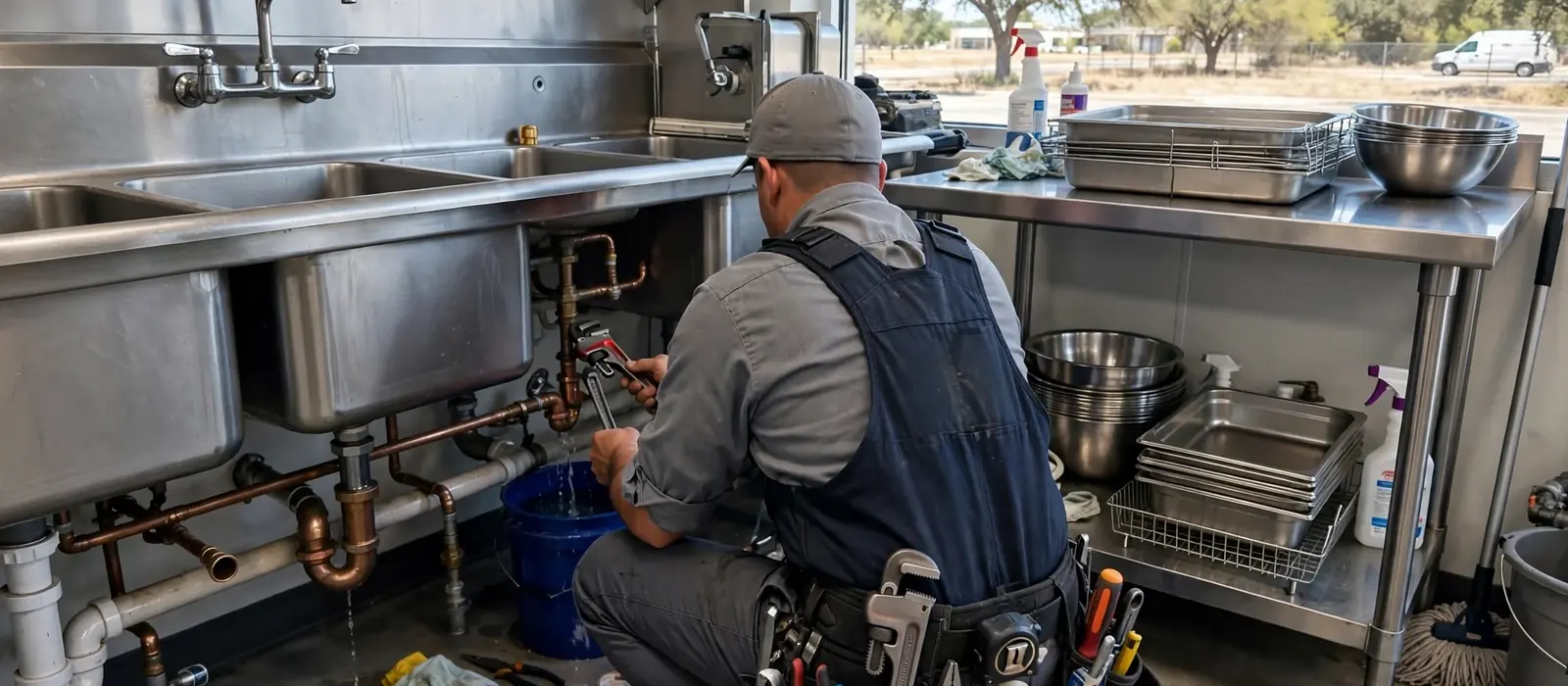
Burst pipe or flood at the shop? What to do right now
Close the main
Find the building main valve, often near the meter or in a mechanical room, and turn it off. Tell us if it will not budge.
Cut power near water
If water is near panels, kitchen equipment or outlets, turn off those circuits only if you can reach them dry.
Lift what you can
Move stock, files and electronics up off the floor, and set out buckets or mats.
Call with the details
Give us the building type, floor, who holds the keys and any alarm. We plan the visit around that.
Commercial leak detection: finding water that is not on the floor yet
Commercial leak detection starts with the meter. Close every fixture, stop the irrigation, ice machines and any equipment on a fill valve, then watch the leak indicator or sweep hand on the meter. If it keeps moving, water is escaping somewhere after the meter. If it stops, the loss is with a specific piece of equipment.
Sub-meters make this faster. In an apartment building or a tenant space, subtract the readings of the individual sub-meters from the main meter. A gap means the loss is in the common lines, such as a riser, a boiler feed or a hidden line under the lot. We then close sections one by one and listen to narrow it down.
What the meter is telling you
| What you see | What it suggests | Usual next step |
|---|---|---|
| Meter moves with everything off | A leak somewhere after the meter | Close sections one by one to narrow it down |
| Meter stops when one valve is closed | The leak is in the line past that valve | Test and inspect that branch |
| Sub-meters add up to less than the main | Loss in a common line, riser or boiler feed | Locate the line and listen along it |
| Meter stops when equipment is unplugged | A fill valve or machine is leaking | Service the equipment |
Allendale, MI: the Lake Michigan Drive corridor
Lake Michigan Drive (M-45) is the main commercial corridor through the township, according to the Master Plan. For a business on that road, tell us the nearest cross street and whether the unit shares a wall or meter with a neighbor, so we know who else is affected by a shutoff.
Grand Valley State University and the rental housing around it also set the pace. About 47% of households in the Allendale census-designated place rent, so property managers and apartment owners are a large part of our work here.
Sources: the township Master Plan and the American Community Survey 2020 to 2024.
Who we work with
Restaurants
Floor drains, grease traps, prep sinks, dishwashers and the kitchen floor sink that backs up on a Friday night.
Offices and retail
Restrooms, break-room sinks, water heaters and the supply line that lets go over a weekend.
Apartment buildings
Risers, shared drains and a unit leaking into the one below.
Property managers
Several units on one call. Landlords near campus can arrange repeat visits with a clear scope each time.
Backflow testing for businesses
Many commercial properties carry backflow assemblies on irrigation, boilers, fire lines or kitchen equipment. Michigan has plumbing rules on backflow assemblies, so ask your inspector or water utility which devices on your property need testing and how often.
If you got a notice about testing, call and tell us what it says. We can check the assembly and tell you what you are looking at. See plumbing installation for installing or replacing the assembly itself.
Grease trap cleaning and why FOG controls matter
Fats, oils and grease, called FOG, cool inside the drain line and build up into a plug. A grease trap catches it before it reaches the sewer, but only if it is emptied before it fills. A trap that is full sends grease downstream, backs up the kitchen and can cause a sewer backup for the neighbor.
Ask the township utility about its grease trap and FOG requirements before you decide how often to clean. Our hydro jetting work clears the lines after the trap when grease has gone past it.
Storm drain and catch basin cleaning
Parking lot catch basins and roof drains fill with leaves, silt and trash. After a hard rain or a spring thaw, a blocked one sends water to the loading dock or the lobby. We clean them out and flush the line behind them, and for a clogged interior drain line our drain cleaning crew can help.
What happens on an after-hours call
Call and describe
Tell us the address, the problem and what you have shut off. Keep the line open.
Dispatch
Active leaks and backups go first. We tell you who is coming and what to prepare. We never promise a clock time.
Price first
We assess, explain the fix and give the price before work starts.
Repair and report
We stop the water, repair or make safe, and give property managers a plain note on what was done.
What decides the cost of commercial work
Commercial jobs vary far more than residential ones. The price follows the building and the problem.
A single shop and a multi-floor apartment building are different jobs.
Locked buildings, alarm codes and after-hours entry affect the plan.
Jetting, camera work and leak-detection gear each add time.
Corroded valves and old pipe turn a quick repair into a longer job.
Overnight calls are priced for the response, and you hear the price before we begin.
Leak or backup at your business?
Call any hour. We answer 24/7 and book same day when a slot is open.
Call (855) 575-2890