
Why there is no single number
Tankless makers publish their own flush procedures, and the circulation time, the solution and the interval between flushes differ by model. A number that fits one brand could be wrong for another. Your manual, or the maker's support page for your exact model number, is the authority.
What changes the time: how much scale is on the heat exchanger, how strong the solution is, how big the pump and hoses are, and whether the unit already has service valves. For planning, allow a couple of hours for a first try, counting setup, circulation, draining and rinse. That is our own rough allowance and not a manufacturer figure.
The general process, step by step
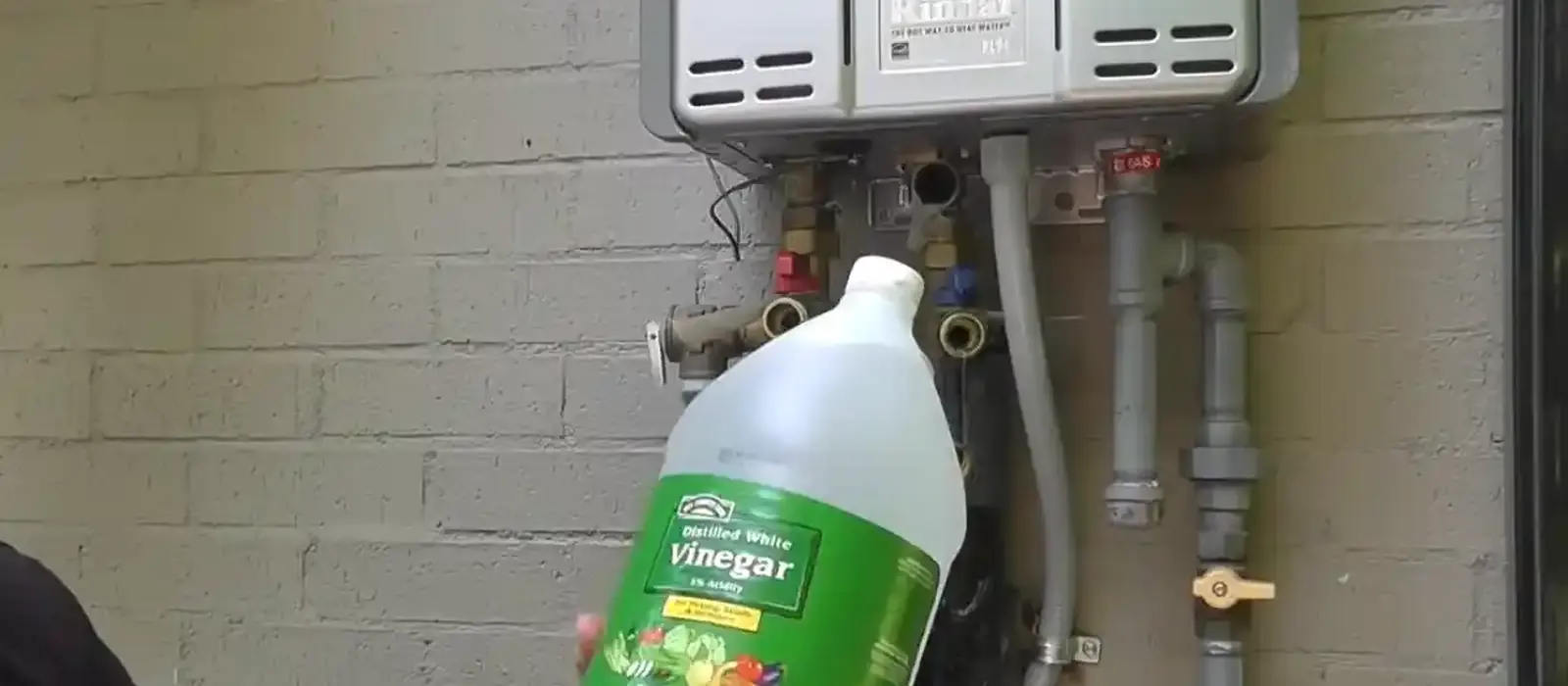
This works only if your unit has service ports or isolation valves. If it does not, adding them is plumbing work, and that is a good time to call. Never mix vinegar with bleach or any other cleaner.
Power and gas off
Switch off the unit's power, close the gas supply if it is a gas unit, then close the isolation valves on the hot and cold sides.
Connect hoses and pump
Attach hoses to the service ports. Run one into a clean bucket and the other from a small pump sitting in the bucket with the solution your manual calls for, which may be white vinegar or a product the maker sells.
Circulate for the time in your manual
Open the ports and run the pump so solution moves through the unit. The manual gives the time, often as a range. Do not cut it short and do not let the pump run dry.
Drain, rinse, clean the filter, restart
Drain the solution, then rinse with clean water until the discharge runs clear. Clean the inlet screen, close the ports, open the isolation valves, bleed air at a hot tap, then restore gas and power.
How to tell the flush is done
Look for clear water, not the clock. The rinse is finished when the discharge runs clear, with no cloudy flecks and no vinegar smell, and the hot taps flow at their normal rate.
After the restart, the unit should fire and reach temperature without an error code. If you still see the same code, weak flow or cycling on and off, scale may not have been the cause. Check the aerators at the taps, then call us.
Scale symptoms and what to do about them
| What you notice | What it may mean | Reasonable action |
|---|---|---|
| White crust on aerators and showerheads | Hard water minerals are present | Test your tap, clean the aerators, and ask whether a softener or filter suits you |
| Hot water flow weaker than before | Scale in the heat exchanger, or a clogged inlet screen | Clean the inlet screen, then flush per the manual |
| A burst of cold water between hot | Scale, a flow issue, or demand beyond the unit | Flush first, then call if it continues |
| Error code for flow or the heat exchanger | Often linked to scale | Look the code up in your manual, flush if it says to, then call |
| Popping or kettle-like noise | Scale on the heat exchanger | Flush, and call if the noise continues |
| Water at the unit or valves | A failed fitting or a worse problem than scale | Shut off the water to the unit and call us |
Codes and fixes differ by maker, so match any code to your own manual.
Allendale, MI: Grand Rapids water and your tap
Allendale Township buys its water from the City of Grand Rapids. The Grand Rapids system reports a 2025 plant-tap average hardness of 142 mg/L, or 8.3 grains per gallon. That is a system average, not a measurement at your faucet, and the township's own water quality report prints no hardness number. Use a test kit or ask your water utility for your own number, because it drives how fast scale builds.
Jenison and Hudsonville are on different suppliers, so do not carry the 8.3 figure to a home there. Parts of Allendale Township without municipal water use private wells and can differ either way, and the Ottawa County Health Department offers water testing.
Source: the City of Grand Rapids 2025 average water analysis, the township's 2025 water quality report, and Ottawa County well-water guidance.
Flush it yourself, or call a plumber?
If the test says your water is hard, a water softener or filter is the longer-term fix. Our tankless water heater service covers flushing, repairs and installs.
Reasonable to do yourself
- The unit already has service valves
- You have the manual, a pump, hoses and a quiet afternoon
- No error codes or leaks to start with
Better to call us
- No service valves, which means installing them first
- A gas unit with any gas smell or ignition trouble
- An error code that returns after a flush
- A leak, or a rental unit that belongs to your landlord
Weak hot water or a code that won't clear?
Call us any hour and describe what the unit is doing. We will tell you what it sounds like and give you the clear price before work starts.
Call (855) 575-2890