
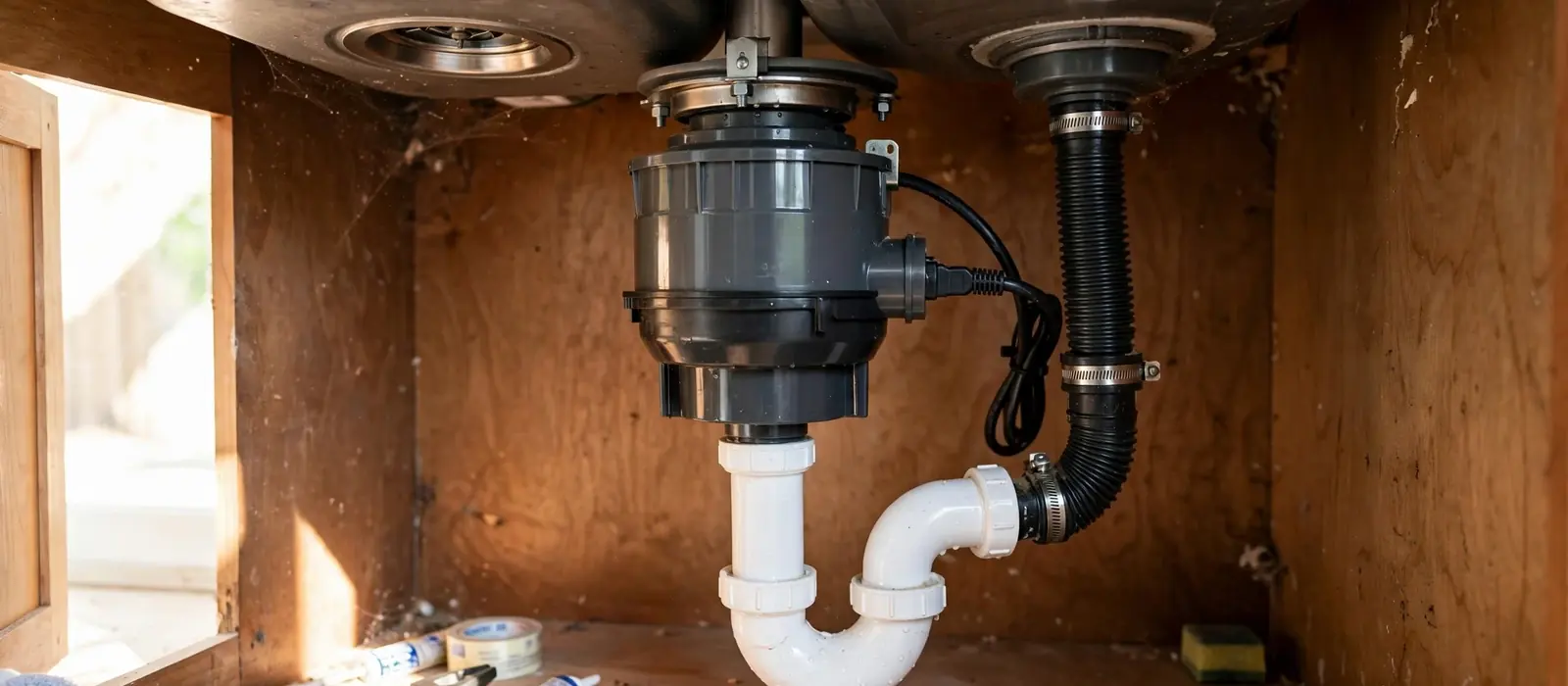
Jammed, humming or leaking: what each one means
Hums but does not turn
The motor has power, and something is wedged between the plates and the shredder ring. Turn the switch off at once. A hum left running can burn the motor.
Silent when switched on
No hum usually means the overload has tripped, the outlet or switch has no power, or the cord has failed. Try the red reset button on the bottom of the unit.
Water under the sink
A leak at the top is the sink flange. At the side, the dishwasher hose or the drain gasket. From the bottom or the housing itself, the unit is done.
Smell or slow drain
Food film coats the chamber and the tailpipe. If the sink still drains slowly after cleaning, the blockage may be past the disposal, and drain cleaning is the next step.
Freeing a jammed disposal without risking your fingers
Do this only with the power off. Never put a hand into the chamber, even when the unit seems dead.
Cut the power
Switch it off, then unplug it or turn off its breaker so no one can start it while you work.
Look with a light
Shine a flashlight in. Remove anything you can see with tongs or long pliers, such as a bottle cap, a fruit pit or a piece of silverware.
Turn it by hand
Many units have a hex socket in the center of the underside. Fit the hex key from the box, or a quarter-inch one, and rock it back and forth until the plates move freely.
Reset and test
Press the red reset button, restore power, run cold water and try it. If it jams again or hums, stop and call.
Leaking disposal: shut it down and keep the cabinet dry
A leaking disposal sends water into the cabinet, where it soaks the floor of the cabinet and can reach the electrical cord. Switch the unit off, close the cold supply valve under the sink, and mop the cabinet so you can see where the next drip appears. We treat this as urgent, because the dishwasher shares the drain and keeps pushing water.
Tell us on the call where the water shows up: top, side or bottom. That tells us whether we are bringing gaskets and putty or a new unit.
What must never go in the disposal
Most jams and bad smells start with something that should have gone in the trash or compost.
Keep it out
- Grease, oil and fat. It coats the chamber, then hardens in the drain.
- Pasta, rice and potato peels, which swell and turn to paste.
- Bones, fruit pits and shells hard enough to dull or jam the plates.
- Fibrous scraps such as celery, corn husks and artichoke leaves.
- Glass, metal, plastic and anything that is not food. Chemical drain cleaner too.
Fine in small amounts
- Soft scraps cut small, fed slowly.
- Citrus rinds, a few at a time, to freshen the chamber.
- Cold water running before, during and after, for about fifteen seconds after you finish.
Replacing a disposal: flange, dishwasher knockout and power
A replacement starts at the sink opening. The old mounting assembly comes out, the sink flange is reseated on fresh putty or a gasket, and the new unit hangs from a mounting ring tightened from below. We then match the discharge tube to the trap, which is where older sinks often need adjusting. See our plumbing installation page for new sink and drain work.
If a dishwasher drains into the disposal, the new unit has a plug inside the inlet called the knockout. It must be knocked out with a hammer and screwdriver, and the loose piece fished out, or the dishwasher will not drain. Missing this step is the classic reason a new unit seems to work but the dishwasher backs up.
The unit needs power from a switch and either a cord or a hardwired connection. We kill the circuit before connecting anything. If the sink has no switch or outlet, an electrician has to add one, and we tell you that up front instead of leaving you with a unit that cannot run.
When repair is not worth it
A jam, a tripped overload or a worn gasket is a cheap fix. A seized motor, a rusted housing, a bottom leak or repeated jams on an old unit are not. If repair would cost close to a new disposal, we recommend the new one and say why. A dripping faucet above the sink is a separate fix, covered under faucet repair.
Allendale, MI: rentals and shared kitchens
In the Allendale census-designated place about 47% of households rent, so many disposals are used by tenants who did not install them. Landlords should check the reset button, the switch and the cabinet floor at turnover, and tell new tenants the list above.
Source: American Community Survey 2020 to 2024.
What to do before we arrive: disposal safety checklist
If the disposal is jammed, leaking or smells hot, these steps keep you safe while you wait.
- Switch the disposal off at the wall switch, then turn off its breaker or unplug it before anything else.
- Never put a hand into the grinding chamber. Use the hex key socket under the unit or a wooden spoon handle from above.
- If it hums but will not turn, do not keep pressing the switch, because that can burn out the motor.
- If water is leaking, close the supply valves under the sink and set a bowl or towel under the leak.
- Do not pour drain chemicals into a jammed unit. Tell us if you already did, so the technician knows.
- If you see smoke, smell burning or find a wet cabinet around a plug, leave the breaker off and call.
What decides the price of a disposal job
A reset and a hex-key free are small visits. A new unit is priced by what has to be fitted and connected.
A gasket or jam is a short visit. A replacement adds the unit and haul-away of the old one.
Larger motors cost more and suit heavier use. We help you pick what fits your household.
A dishwasher connection adds the knockout, the hose and a check of the high loop.
A sink that already has a switch and outlet is simple. Anything else may need an electrician.
Disposal leaking or jammed?
Call day or night. We book the earliest visit we have open.
Call (855) 575-2890