
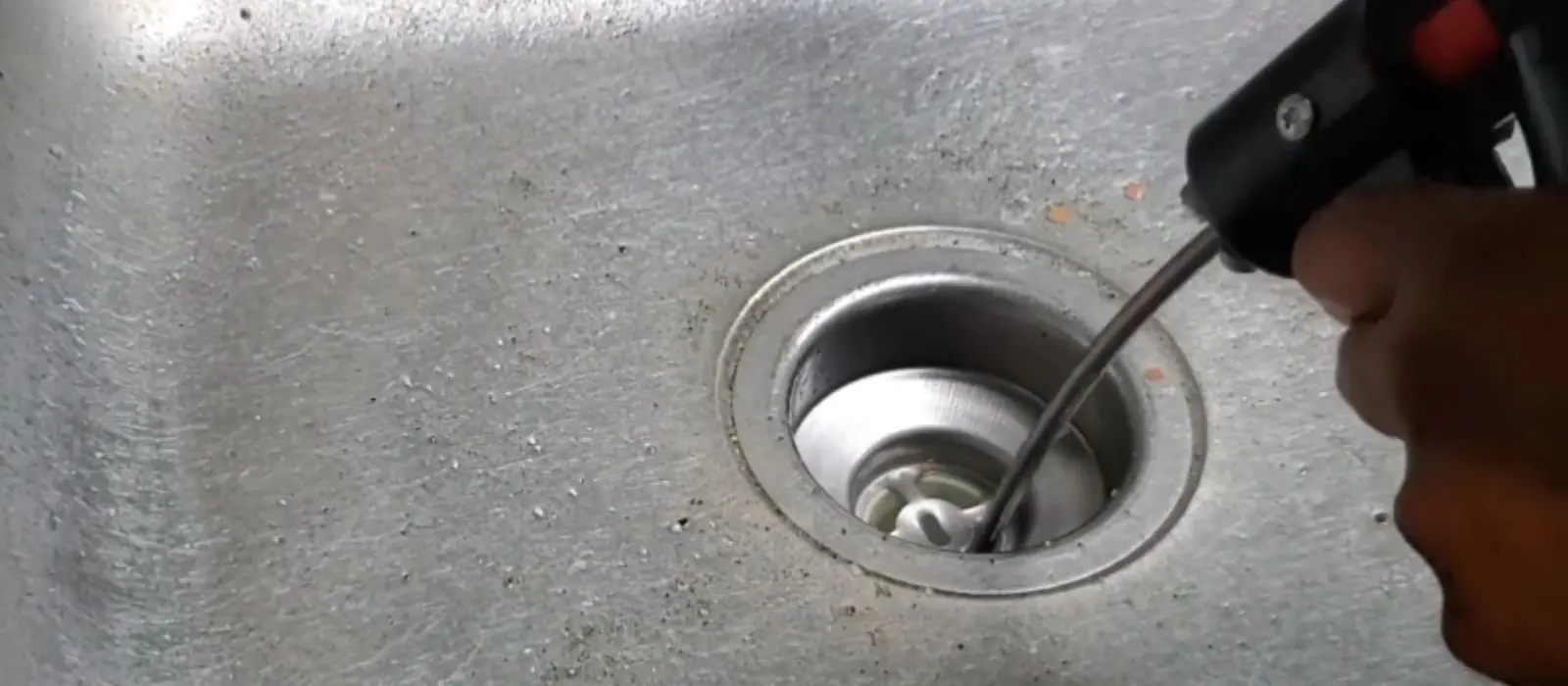
Why bleach doesn't unclog anything
A clog is physical. It is a mass of hair, soap film, food or wipes that blocks the pipe. Bleach is a disinfectant and stain remover. It reacts with some organic material, but it does not dissolve hair or break up a wad of paper in any way you can count on.
What you usually get is a drain that smells like bleach, still holds water, and now has a chemical sitting in the trap. When the plunger goes in, that liquid comes back up at you.
Bleach does have a job: wiping down a basin, a tub or the rim of a drain opening for mildew. Used that way, at the strength the label gives, it stays in its lane.
Never mix bleach with other cleaners: toxic gas can result
Bleach combined with ammonia, with acids or with drain cleaners can release toxic gas. It can happen inside a drain, a toilet bowl or a bucket, and faster than you can react. There is no safe small test.
- Do not add bleach to a drain that already has any other product in it, even if that product went in days ago.
- Do not follow a drain cleaner with bleach, or a toilet cleaner with bleach, hoping to boost it.
- Do not combine bleach with ammonia-based glass or floor cleaners, vinegar, or any acid-type bathroom product.
- If you smell sharp fumes or your eyes and throat burn, leave the area, get fresh air and call emergency services or poison control.
What bleach does and what a clog needs
Bleach in the drain
- Disinfects and lightens surfaces
- Does not remove hair, grease or paper
- Leaves a chemical sitting in standing water
- Creates a gas risk if anything else is in the line
- Large or repeated amounts can harm septic tank bacteria
What actually clears it
- A plunger for soft blockages near the fixture
- A hand auger for hair and soap a few feet in
- A cable machine for deeper or repeat clogs
- A camera to see what is really in the line
- Nothing to mix and nothing to splash
A safe order of operations
Ask what is already in it
Think back over the last few days. If any cleaner, acid or drain product went in, do not add anything and do not plunge until the room is ventilated. If you are unsure what went in, stop and call.
Go mechanical
Wear gloves and eye protection. Use a plunger, then a hand auger if needed. Pull the clog out and bag it, because bleach and chemicals are not the tool for this.
Rinse and ventilate
After the water runs freely, run plain water for a few minutes and keep the fan or a window open. Clean the basin with a single product, one at a time, never two together.
Call at the first red flag
More than one fixture slow, gurgling from a drain, water that returns after you clear it, or a sewage smell all point to the main line. Stop using water and call.
Allendale, MI: sewer lines, lift stations and septic tanks
The township runs its own sewer system, with about 50 miles of sewer main, 8 lift stations and a Water Resource Recovery Facility rated for 1.6 million gallons a day, with an expansion under way. If several drains back up at once, the blockage may be in your own line or in the public main.
Ask the township utility where its responsibility ends, and look up its posted daytime and after-hours numbers for sewer emergencies on its water and sewer page before you need them.
Rural properties are different. Private wells and septic systems fall under the Ottawa County Health Department. If you have a tank, ask the department what your system can tolerate, because the bacteria in the tank are the whole treatment process and a jug of bleach poured into a drain is not normal household use.
Source: Allendale Charter Township water and sewer page and Master Plan.
Not sure what went into the drain?
Call the 24/7 line before you plunge or add anything. Tell us the products involved and we will say what to do next, with the clear price before work starts.
Call (855) 575-2890When the clog is bigger than a bottle
A slow sink on its own is a drain cleaning job. When the whole house is slow, the cause is usually the main line, and sewer line cleaning with a camera shows whether the cause is roots, grease, a belly in the pipe or something that does not belong there.
We work in nearby towns too, including Hudsonville and Walker, about 10 miles east across the Grand River. The advice does not change by address: mechanical first, no mixing, and a call when the signs point to the main.